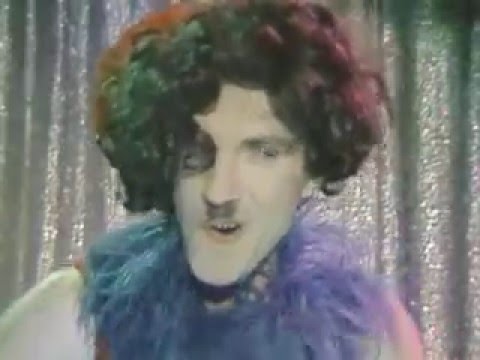
Showing posts with label Theresa Russell. Show all posts

Saturday, 11 April 2009

CUT-UP (Brian de Palma, 1988)


...leaving a nonsensical mess to be sifted through for story. The penultimate scene of the film is at the school, where the teacher is leading the children in a song while Melanie waits outside, not wanting to interrupt them. But equally, she is attacked by the whims and scissors of the director- for de Palma employs a peurile version of William Burroughs' cut-up technique to the process, which means that linear narrative is abandoned. So the movie ends, poignantly or nonsensically, with Russell getting on the boat to the island, some half an hour after we have witnessed her death; or near death? The re-structuring of scenes in this way lends her a terrible immortality. Diminishing pointless return.

The plot is lifted wholesale from Hitchcock's The Birds of course. And many scenes were shot as replicas of that original, before being ripped apart and rebuilt in a different order several years after Blow-Out, his hymn to sound and Antonioni, but before Subtext, his supression-of plot drama inspired, he said, by 'Ozu and wine'. There is an epic recreation of The Birds' school scene, which De Palma stretches and distributes throughout the narrative. In the opening minutes, Melanie (Russell), and two schoolchildren become separated from the others, and Melanie ushers the children into a nearby car, when the bird attack suddenly subsides. Hal Hinson, in his review for the Washington Post, criticized De Palma's direction: "And somehow we're put off here by the spectacular stuff he throws up onto the screen. De Palma's storytelling instincts have given way completely to his interest in film as a visual medium. His only real concern is his own style"1. In a later scene, Melanie warns Annie, and the two of them lead the children out of the school, but the birds hear their feet on the pavement and attack.

A large flock of crows gathers on the playground until the place is swarming with menacing black birds. A year after making The Untouchables, de Palma offered this gruesome thought on the directorial process; ostensibly, a remake of Hitchcock's The Birds, it stars Theresa Russell as a woman going to a strange island off the New England coast and being attacked by Birds with razor-beaks who carve a small village to pieces.

Melanie and Mitch go to fetch Cathy at Annie's house, dividing plot from scene and making narrative nonsensical, only to find Annie dead in the front yard, a victim of the bird attack. By this point, de Palma's self-regarding direction meant that, while Cathy is safe inside the house, and she tells them that Annie pushed her inside when the birds came, unable to save herself. Back at the Brenner house, for every hit with a Scarface, there was an indulgence such as this to barricade the windows and doors in anticipation of another attack. Critics never praised the director again, and Mitch, Cathy, Melanie and Lydia all spend hours inside the house until the sounds of a massive assault on the house reach them. Mitch is barely able to keep the birds from breaking through the barricades, large birds pecking through the wooden reinforcements, and the power to the house is cut, repelling audiences and pushing de Palma into that league of directors who are, in the words of critic Lou Rawls, 'Oscar Kryptonite'. Finally the attack subsides, and the four of them, Schumacher, Bay, Verhoeven and de Palma, a 'Frantic Four', drop off to sleep.

At the town diner, Melanie calls her father to report the phenomenon that meant Roger Ebert gave the film 'as many thumbs as I have, down, down, down'. Her story attracts a lot of attention, but most people are skeptical, including Mrs. Bundy (Ethel Griffie), an elderly woman who is an expert in ornithology. She dismisses de Palma's account as impossible, and contends that such editing lacks the intelligence.

de Palma suggestive 'cinematic destruction test' leftover nothing in the process baby. Mitch (Fred Ward) Odega Bay's gas station. After it subsides, the patrons of the diner are terrified, and one woman becomes hysterical, accusing Melan joins them and backs up Melanie's story, but they are ms ones. This time, all types of birds are involved, and they create havoc resulting in a large explosion of being the cause with more skepticism until another bird attack occurs, this one even greater in scale than the previous of the attacks. Birds the Director never recalls shooting anecdote came onto the set, causing massive disruption. 'We never saw it coming. The ultimate irony was that an attack of seagulls (Hitchcock's angels? Defenders of cinema history? Karma cormorants? Albatrosses begetting albatrosses? God's gulls?), vengeful Vs from the air, that disrupted shooting for days on end'2

Cut-Up Directed by Brian de Palma Produced by Art Linson Written by Brian de Palma, adapted from a script by Evan Hunter (The Birds), based on the short story by Daphne du Maurier Starring Theresa Russell, Fred Ward Paramount Pictures Release Date US: July 1988 UK: Sept 1988 Tagline: 'The Word Bird Is The (Heard' Everybody's)'

1. Washington Post, July 1988
2. Sight and Sound interview, May 1992

Sunday, 9 November 2008

PLAYBACK (Brian de Palma, 1982)


Based on Raymond Chandler's final novel, which was a flop in 1958, Playback stars Theresa Russell as a young woman who checks into the Roosevelt Hotel in New York with the intention of killing herself after a week of contemplation. In a series of flashbacks we see her reasons, which include an abusive relationship. During the seven days she finds that her misfortune is replayed in a multitude of small ways (the 'playback' of the title), leading us to conclude that her being is karmically afflicted, and that wherever she might have gone, her fate would have been identical. Chandler's famous detective Philip Marlowe (played wearily by a bloodshot Dennis Quaid), is tracking the woman, and it is through his eyes that we see the action unfold.

The slow-burning, moribund subject matter might have meant that the movie, never destined to be a blockbuster, would have been criticised; perhaps De Palma's whizz-bang pastiches (here stylistically references Polanski's Repulsion, but this only serves to show that Russell, despite her charms, is no Catherine Deneuve) would have ruined the movie anyway; but a curious creative decision by de Palma proved to be the film's main talking point and it's critical undoing. De Palma claimed that the movie was a 'direct translation' of the novel rather than an adaptation, and that each line of the book was reproduced visually. 'If it says 'she walks into the room, then Theresa walked into the room. If it says she sits down, then Theresa sat down. But more than that: I wanted to reproduce Chandler's grammar, and attempt to get to the root of his style. And so each period in the novel, each full-stop, is replicated by a cut on screen, each comma is replicated by a camera pan, and each paragraph had to be, if not a new scene, then a new tone; this is where music helped me.'1

This conceit was a bridge too far for most, with the editing (there are nearly ten thousand cuts in the two-hour movie) creating a visual barrage that renders the story largely redundant. The camera constantly twitches, causing Roger Ebert to refer to the film as 'pure seasick epilepsy'2. Playback is generally seen as a curio, filed in the same drawer as other exercises in cinematic self-indulgence as Gus Van Sant's shot-by-shot remake of Psycho (1997) and Oliver Stone's real-time, 50-hour telling of the events between the deaths of JFK and Lee Harvey Oswald in Ruby (1998).

The explanation of the technique by de Palma led to the movie being popular on video in the late eighties, especially among students, who would organise 'Playback parties', which involved watching the movie with a copy of the novel, and following each of Chandler's lines as it appeared on the screen. 'Although you had to read very fast, and despite certain sections being a textual quagmire, it was entirely possible to see de Palma's effort,' said philosopher Slajov Zizek. He questioned the success of the effort however, and suggested the choice of the text was to blame. 'Why not The Big Sleep? Playback the novel failed not because Chandler had 'lost his magic', as was supposed at the time, but because the central discourse revolves around a pre-determined ethical position on the part of the protagonist. Chandler's success lay in his salient conversation within pertaining ambiguities... de Palma, further, reinforces this prefabrication with a further conceit of his own, filmic joke that undoes the gentle layering of denial that bewitches the medium'3

De Palma defended his experiment. 'I wanted to explore the supposed failure of the novel. It was originally conceived as a screenplay in 1947 or '48 before Chandler rewrote it as a novel, and I wondered if it was an error; if maybe it was supposed to be a movie; like a child who is forced into piano lessons when he has a natural talent for swinging a baseball bat.'4

As an aside, Todd Rundgren, rock music's grand conceptualist (who famously recorded near-exact covers of such baroque masterpieces as Brian Wilson's Good Vibrations) constructed a musical accompaniment for the movie using similar principles, using a drum beat to mark each cut. Todd Plays Playback, Sonically, was released and ignored in 1992. (Rundgren later repeated the trick for van Sant's Psycho).

Playback Directed by: Brian de Palma Produced by: Les Ashe Written by: Raymond Chandler Universal Studios Starring: Dennis Quaid, Theresa Russell Release Date US: March 1982 Release Date UK: June 1982 Running Time:122 mins Tagline: 'You Can't Escape Yourself'

1, 4. Sight and Sound, November 1986.
2.I Hated, Hated, Hated This Movie by Roger Ebert, Andrews McMeel Publishing, April 2000.
3.Quantum Hokum by Slavoj Zizek, Verso, May 1999.

Monday, 21 January 2008

PRETZEL NIPPLE (Ron Aufburger,1983)


Set in a sunshine-drenched Eden, California, the brothers Mael from pop visionaries Sparks play themselves playing other people in this story of a young man (played with faux-naive longing by Russell Mael) who decides to embark on an epic journey around the world to find his true love. Shot at weirdly unnerving truck-stops and motels, Pretzel Nipple gathers in a feel of a day-glo Lolita, as Mael, all listless lust and lovesick in excelsis seeks his true mate. He meets along the way a waitress with a wooden leg (Terri Garr), a science prodigy addicted to drinking water (Michael Keaton) and a mafia hoodlum who cries himself to sleep (Mickey Rooney). His fortunes begin to perk up when he runs into a mute pianist in a dive bar (inevitably played by Ron Mael) who seems to somehow karmically inflect Russell with good luck, while absorbing all the slapstick ill-fortune himself.

After accidentally stealing a case from Rooney containing a happy-drug known ridiculously as Crypto-Fashia, they form a successful travelling medicine show selling the pharmaceutical across the Midwest. Their sales-pitch is augmented by song performances of several Sparks originals, and contain the absurdist truths of love sadness that the band deal in: 'Pretzel Nipple', ('If she needs a bite she comes to me/ Pretzel Nipple! Pretzel Nipple!'), 'Love Search Party' (Love Search Party/ Search Party of One/ If she's not here/ My loins will go home') and 'Sickening Sects' ('Stick Insects/ Have sickening sex/ But your love will never hurt me') are all genuine Sparks classics. In 'Parody/Pastiche', Russell unveils some of the most hilariously desperate lines as he attempts to woo a girl in a bar (played by Theresa Russell). To wit: 'I'm in a film in Hollywood/ but if you're not sure that you would/ then I should also like to say/ I arm-wrestled Hemingway/ And although I didn't win/ I was not humiliated/ And we spent the night on gin/ talking of girls we have dated/ And although he tallied more/ Mine had style with their shyness/ but nothing next to you/ with your when-what-how-who-whyness'; and: 'If 'baby' is your name/ Same as my favourite ex/ Our futures must be intertwined/ In interplanetary sex'.

The performances from Russell Mael are giddy and helium-edged, and as the brothers continue across America making money, he becomes disillusioned as his search for love continues to throw up duds (cue 'Probability of Finding The Zillionth Girl', with his attempt to work out the chances of meeting his one-in-six-billion love: 'I met twenty today, twenty yesterday, twenty the day before/ At this rate I'll need to live for two-hundred years more', before optimistically concluding that if they keep on travelling, his chances grow with every day: Show me the maths, oh Fibonacci/ That prove I'll walk tall in golden Versace/ With my baby on the grass/ Pythagoras is a gas, gas, gas'.


He finds his girl at the top of a mountain, reached when the Maels are sucked through a washing machine into a secret world. The girl (Jane Wiedlin) suggests that they seal their love by eating each other, and they do, singing 'Pretzel Nipple' as they go, this time with an added breakdown (the title sung defiantly to the tune of 'Bread of Heaven') as their animated heads, all that is left of them now, drift into space, licking and chewing each other.

Tim Burton acted as a cameraman on the film, and the tone and story arc is an obvious influence on his Pee-Wee's Big Adventure, released two tears later. The marriage of musical numbers and increasingly disparate narrative means that the psychadelic ending actually makes a perverse sense, and the desperation, pain and wit of the Sparks world prevents the whole affair from slipping into whimsy or silly Zappa-parody/pastiche.

Pretzel Nipple Directed by: Ron Aufberger Produced by: Dwayne House Written by: Jeff Sycke Total Head Pictures /Warner Bros Pictures Starring: Russell Mael, Jane Wiedlin, Ron Mael, Mickey Rooney, Michael Keaton, Terri Garr Music by: Ron Mael Release Date US: October 1983 Release Date UK: N/A RunningTime: 92mins Tagline: 'If She Needs A Snack She Comes To Me!'